How to Keep Kids Active in Hot Summer Weather: A Parent’s Backyard Play Plan
The familiar summer dilemma sets in: children still need physical activity and fresh air, but the intense midday heat changes how families must plan for it. While moving outdoors provides vital benefits for development and energy release, extreme temperatures demand a more thoughtful approach than simply sending the kids into the backyard.
Hot weather does not have to end active play, but it does require a different routine. A high heat index and direct sun exposure can quickly make a normal play session uncomfortable or unsafe. To keep children moving safely during the peak of summer, parents need a flexible strategy. By checking local conditions rather than relying on the clock, using a responsive Plan–Play–Pause routine, inspecting every surface, and choosing backyard equipment designed with shade and durability in mind, you can preserve the fun of outdoor play without ignoring the reality of the heat.
When Is It Too Hot for Kids to Play Outside?
The American Academy of Pediatrics (AAP) advises that a heat index of 90°F warrants caution for active outdoor play, and a heat index of 105°F or above marks a "danger day" when families should limit their time outside. The heat index combines air temperature and relative humidity to describe how hot the conditions actually feel to the human body.
The most important step in planning a summer day is knowing when outdoor play is appropriate. It is tempting to use a rigid schedule, but heat conditions vary widely depending on your region, humidity, and the amount of shade in your yard.
Always remember to check the local HeatRisk forecast and air quality information when deciding whether to head outdoors.
| Condition | Family Response Needed | Checks |
|---|---|---|
| Mild to warm (Below 90°F heat index) | Normal play is generally acceptable. | Check surfaces if equipment is in direct sun. Provide water. |
| Caution zone (90°F to 104°F heat index) | Move play to cooler morning or evening hours. Reduce intensity. | Strictly enforce shade, rest, and water breaks. Check all surfaces. |
| Danger day (105°F+ heat index) | Limit outdoor time. Move active play indoors. | Do not rely on shade or hydration alone to make extreme heat safe. |
Source note: Thresholds based on AAP guidance. Individual health conditions may require stricter limits.
Use a Plan–Play–Pause Routine
When conditions allow for outdoor activity, a simple Plan–Play–Pause routine helps ensure the session remains safe and enjoyable.
Plan in cooler windows: Schedule the most strenuous activities for the early morning or the evening when the sun is lower and temperatures drop. It is advisable to avoid late morning through midafternoon when the sun is strongest. Dress children in lightweight, loose-fitting, light-colored clothing, which helps keep them cooler.
Play with preparation: Before anyone heads outside, set up a shaded resting area and bring plenty of fluids. Children rely entirely on adults to keep them hydrated. Avoid sugary drinks and encourage regular sips of water before children even ask for it.
Pause early and often: Do not wait for children to complain of the heat. Build in mandatory cooling breaks. If the heat becomes overwhelming, or if a child shows any signs of heat stress, pause the outdoor session immediately and move indoors.
Make the Backyard Work Harder Without Making the Day Harder
Keeping kids engaged when the temperature rises often means lowering the physical intensity of the play. A well-equipped backyard can support this by offering a variety of activities that do not require constant running or heavy exertion.
Instead of an hour of high-energy tag, encourage a "three-zone" rotation. Children can spend a few minutes on active climbing or swinging, move to a shaded area beneath a play deck for imaginative role-play, and then transition to a calm, low-intensity activity or an indoor cool-down.
For example, the Sun Valley Swing Set from Gorilla Playsets includes a rock wall, a rope ladder, and monkey bars for active moments, but it also features a tic-tac-toe panel, a steering wheel, and a play telescope that encourage slower, creative play under the shade of its canopy. Having multiple options in one footprint gives parents an easy way to alternate active play with imaginative or lower-intensity activities.
Treat Every Slide, Swing, and Surface as a Same-Day Safety Check
A common misconception is that parents only need to worry about the temperature of older, bare-metal slides. In reality metal, plastic, rubber, and even the ground surfacing around a playset can become hot enough to cause thermal burns.
Before letting children play, an adult must inspect the equipment.
- Check the slide bed: Even light-colored plastics can absorb significant heat if left in direct, prolonged sunlight.
- Feel the swings and chains: Check the seats and the chains where small hands will grip.
- Test the climbing grips: Ensure rock wall holds and ladder rungs are comfortable to the touch.
- Inspect the surfacing: Asphalt, concrete, and dark rubber surfacing can heat up rapidly. Ensure children wear appropriate footwear.
Choose Backyard Play Features With Hot Days in Mind

If a surface feels hot to an adult hand, it may be too hot for a child's bare skin, which is thinner and burns more quickly. Furthermore, because some materials transfer heat slowly, a quick tap might not reveal the true temperature. Always err on the side of caution.
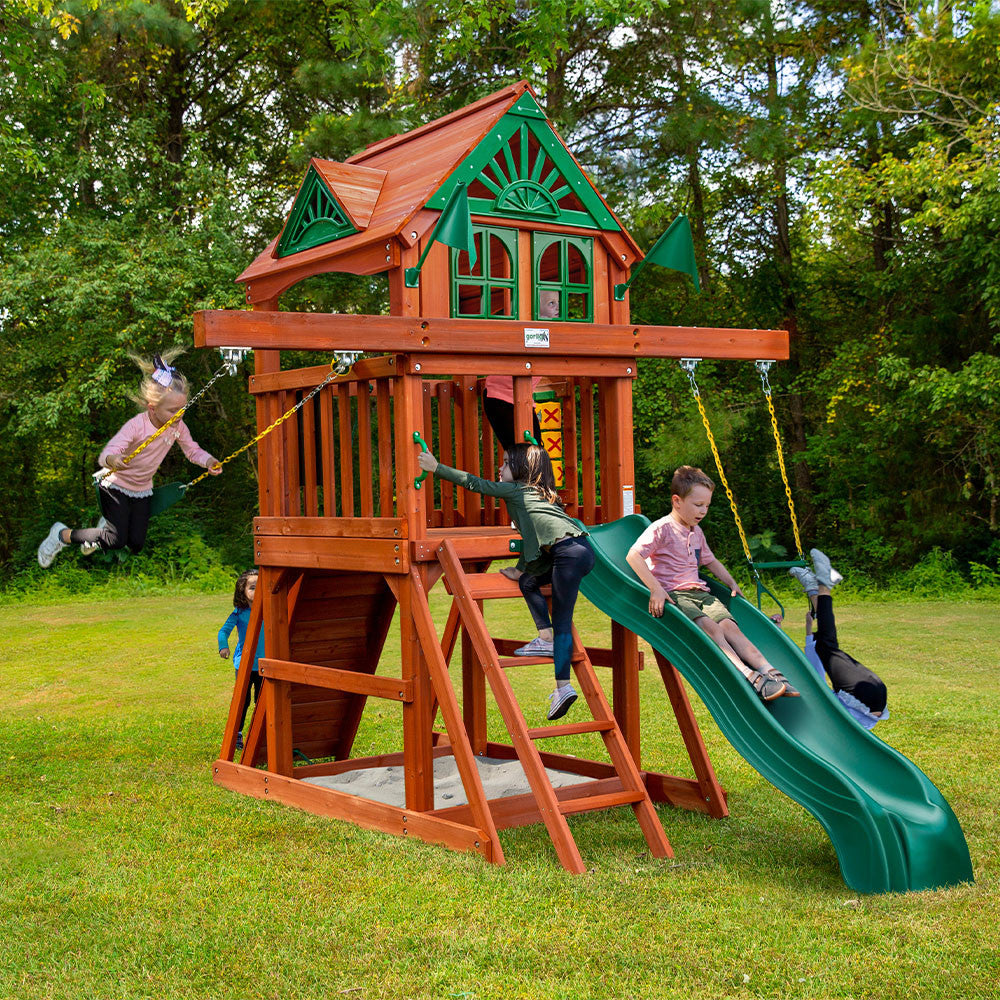
Many families prefer wooden swing sets their natural appearance, structural strength, and ability to support larger, more varied play features as children grow. Gorilla Playsets uses high quality cedar wood that is naturally resistant to rot, insects, and mildew. These durable playsets will provide a safe play space for years to come.
When evaluating a playset, look for specific features that mitigate sun exposure:
- Shade overhead: On the Sun Valley model, Gorilla Playsets says the deluxe vinyl canopy provides shade and helps keep the play deck cooler on sunny days. If a model offers a canopy or roof, confirm its coverage and features on the product page.
- Coated chains: On the Skyline Lookout, Gorilla Playsets says its plastic-coated chains have UV protection intended to help keep chains cooler; on the Outing model, it describes Plastisol-coated chains intended to help prevent pinched fingers and keep chains cool.
- UV-protected slides: Gorilla Playsets says its current product range includes UV-protected slides. Confirm the feature list for the specific model you are considering.
Remember that while a canopy provides shade and coated chains may improve comfort: every exposed surface must still be checked before play.
Keep Summer Play Moving
The goal of summer planning is not to maximize the number of minutes spent outdoors; it is to make the time you do spend outside responsive, enjoyable, and appropriate for the conditions.
By building a repeatable daily check into your routine, avoiding the hottest parts of the day, and inspecting every surface, you can help protect your children from the heat. Choosing a versatile playset with built-in shade and varied activities gives your family the flexibility to enjoy shorter, safer play sessions all season long.
Explore the full range of Gorilla Playsets wooden swing sets to find the right combination of shade, features, and durable cedar construction for your backyard.
FAQs About Kids Playing Outside in the Heat
How hot is too hot for a child to play outside?
Pediatricians generally recommend bringing children indoors or moving them to heavy shade when the heat index reaches 90°F. Young children absorb heat faster than adults and are more susceptible to heat exhaustion.
How much water should a child drink when playing outside?
Children need between four and eight cups of fluids daily, depending on their age. On hot days, this amount should increase, and parents should enforce water breaks every 15 to 20 minutes during active outdoor play.
How can I keep my swing set cool in the summer?
Position the playset in partial shade if possible, and choose equipment with heat-resistant features like vinyl-coated chains and UV-protected slides. You can also add a canopy over the play deck to create a shaded area.
What are the first signs of heat exhaustion in a child?
The early signs of heat exhaustion include muscle cramps, pale or clammy skin, nausea, headache, extreme fatigue, and unusual irritability. If these occur, move the child to a cool place and provide fluids immediately.
Leave A Comment
Your email address will not be published. Required fields are marked with *
More Articles

Creative Ways to Upgrade Your Swing Set with Accessories
Your structure may be in good condition, but the play routine has become repetitive and lackluster. If you can relate, you might be suffering from a case of swing set burnout. Never fear — we're ...
Read More
Small Backyard Swing Sets: Best Compact Swing Sets for Tight Spaces
Smaller backyard? No problem! Your family doesn’t have to skip the swing set; you just need smarter space planning. Gorilla Playsets' small swing sets are designed for compact backyards while sti...
Read More